
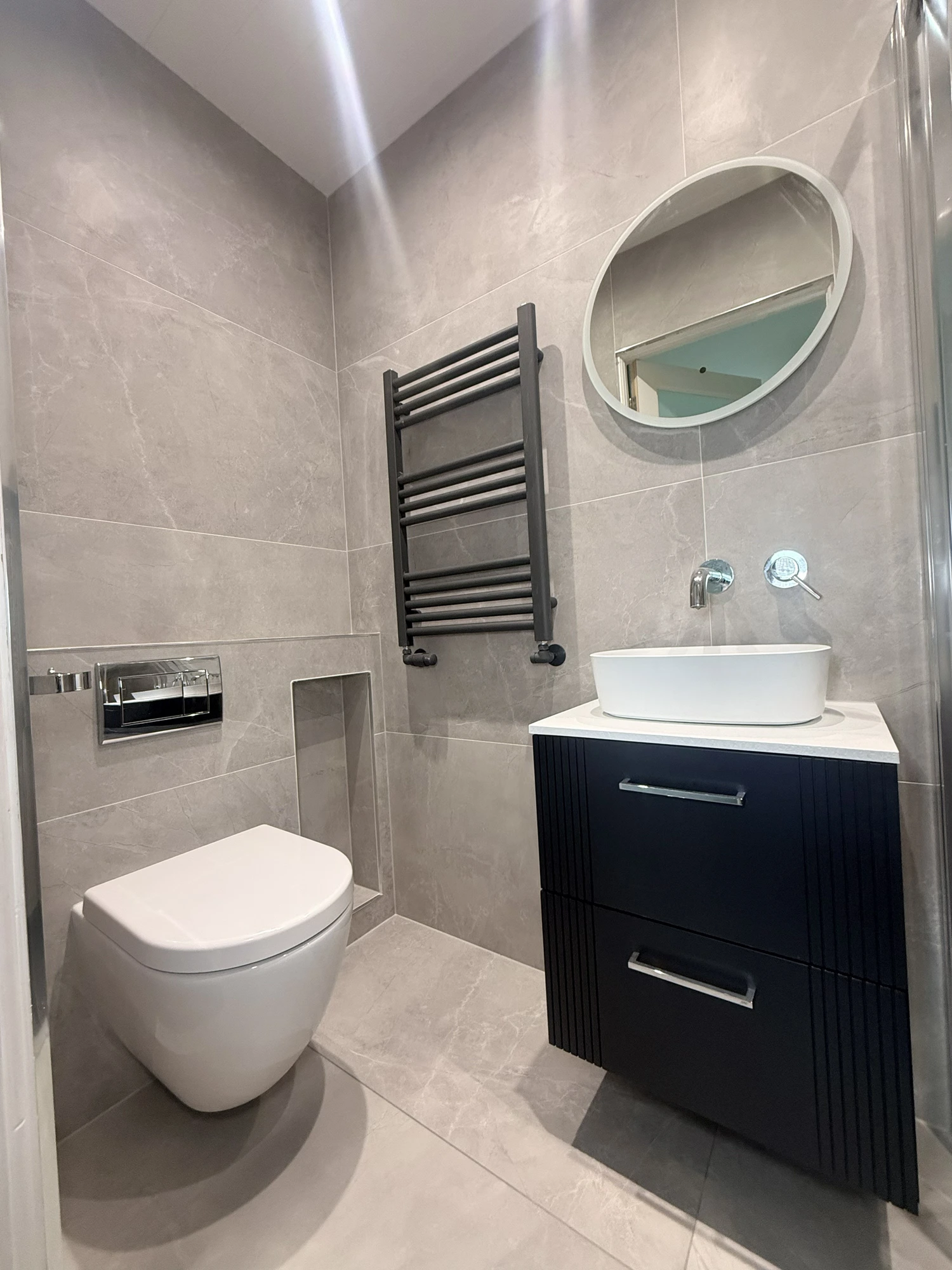

If you’ve got a bathroom that feels cramped, awkward, or just plain frustrating to use, you’re not alone. We renovate small bathrooms every week, and the transformation still surprises people. A space that felt poky and dated can become somewhere you actually enjoy spending time.
The secret isn’t magic. It’s smart design choices that make the most of every centimetre. The right fixtures, clever storage, and a few visual tricks can make a small bathroom feel twice its actual size.
This guide shares the ideas and approaches that work best in compact spaces. Everything here comes from real experience fitting out small bathrooms across Dublin.
Space Saving Ideas That Actually Work
Let’s start with the practical stuff. These are the changes that genuinely free up space, not just create the illusion of it.
Wall Hung Toilets and Basins
This single change makes more difference than almost anything else you can do in a small bathroom.
When the toilet and basin float off the floor, the room immediately feels more open. Your eye sees continuous floor space stretching to the walls, and your brain registers that as a bigger room.
There’s a practical benefit too. No pedestal to clean around, no awkward gap behind the toilet where dust and hair accumulate. A quick mop covers the whole floor.
Wall hung units need a support frame concealed in the wall, which does eat into a few centimetres of depth. But the visual gain far outweighs this. And that false wall behind the frame? Perfect for concealed storage or recessed shelving.


Built In Storage
Freestanding cabinets eat into floor space. Recessed storage does the opposite; it creates room where there was none.
A niche in the shower wall holds shampoo bottles without a clunky shelf or caddy. A mirrored cabinet over the basin provides storage behind the mirror you’d have anyway.
The cavity behind a wall hung toilet frame is particularly useful. That void can house a slim storage unit with shelves or drawers, turning dead space into somewhere to keep toilet rolls, cleaning supplies, and toiletries.
Corner Installations
Corners are wasted space in most bathrooms. A corner basin tucks neatly into a 90 degree angle, leaving the main wall clear for other fixtures.
Quadrant shower enclosures (the ones with a curved front) fit into corners while giving you a surprisingly spacious showering area.
Even corner toilets exist, though they’re less common. If you have an awkward layout with an obvious empty corner, it’s worth considering.
Sliding and Folding Shower Doors
A hinged shower door needs clearance to swing open. In a tight bathroom, that swing might clash with the toilet, basin, or the main door.
Sliding doors run on a track and need zero swing space. Bi fold doors concertina inward, again avoiding the clearance problem.
These aren’t just functional compromises either. Modern sliding door systems look sleek and operate smoothly. Some of our clients actively prefer them to traditional hinged options.


Consider a Wet Room Design
Removing the shower tray and enclosure entirely transforms a small bathroom. A wet room floor slopes gently to a drain, and the shower becomes part of the room rather than a separate box within it. The visual difference is dramatic.
Wet rooms require proper waterproofing (tanking) across the entire floor and up the walls, so they cost more to install than a standard shower. But in a really tight space, they’re often the best solution. You can still add a glass screen to contain most of the spray while keeping that open, flowing feel.
How to Make a Small Bathroom Look Bigger
Beyond the structural changes, there are visual techniques that trick the eye into perceiving more space. Interior designers use these all the time, and they work just as well in bathrooms.
Keep Colours Light
White, cream, soft grey, pale blue. Light colours reflect more light around the room, making it feel airy and open. Dark colours absorb light and can make a small space feel cave like.
This doesn’t mean your bathroom has to be boring. You can add interest through texture, subtle pattern, or a single feature wall. But the dominant palette should stay light if space is tight.
Go Big With Tiles
It sounds wrong, but larger tiles actually make small rooms feel bigger. Every grout line is a visual interruption. Fewer lines means a calmer, more continuous surface that reads as more spacious.
Tiles in the 600x600mm range work well in most small bathrooms. Some people go bigger, using 600x1200mm or even larger formats. The effect is striking, almost like the walls are made of stone slabs rather than individual tiles.
Continuous Flooring
Using the same tile on the floor and continuing it up onto the walls blurs the boundary between surfaces. The room reads as one unified space rather than a collection of separate planes. This is especially effective in wet rooms where the floor tile runs right into the shower area.
Frameless Glass
Shower screens with chunky frames create visual barriers. Frameless glass (or minimal frame designs) allows sightlines to continue uninterrupted. You see the wall behind the glass, not the glass itself. The shower area becomes part of the room, not a separate compartment.
Mirrors Work Wonders
A large mirror over the basin is a given, but think bigger. A full wall mirror, a mirrored cabinet that spans the width of the room, or even mirrored tiles can double the visual depth of a space. Mirrors also bounce light around, reinforcing that sense of openness.
Position matters too. A mirror reflecting the window (or a light source) maximises brightness. A mirror facing a blank wall just doubles the blankness.
Layer Your Lighting
A single harsh ceiling light flattens a room and creates unflattering shadows. Multiple light sources at different levels add depth and interest. Consider a main ceiling light (ideally dimmable), lighting around or behind the mirror, and perhaps a small accent light in a niche or above the shower.
LED strip lighting has become popular for good reason. Tucked under a floating vanity or behind a mirror, it adds a soft glow that makes even the smallest bathroom feel welcoming.
Downstairs Toilet Ideas
The downstairs WC is a special case. Often tiny, sometimes tucked under stairs or into odd corners, these little rooms have their own design challenges. But they also offer opportunities to do something bold.
Make a Statement
Because a downstairs toilet is small and usually only visited briefly, you can get away with design choices that might be overwhelming in a bigger space.
Bold patterned tiles, dramatic wallpaper (use vinyl or specialist bathroom options), deep colours, striking light fixtures. This is your chance to have some fun.
We’ve fitted cloakrooms with emerald green tiles, geometric black and white patterns, and luxurious marble effect porcelain.
In a tiny room, a strong design decision creates impact. Playing it safe often just looks bland.


Cloakroom Basins
Cloakroom basins are specifically designed for tight spaces. Some are as narrow as 250mm front to back, yet still perfectly functional for washing hands.
Corner basins, wall mounted mini basins, and basins that sit on top of slim vanity units all save precious centimetres.
If space really is that tight, a basin with an integrated tap (where the water flows directly from the basin body) eliminates the need for clearance behind a separate tap.
Compact Toilet Options
Standard toilets project about 650mm from the wall. Short projection models bring this down to around 600mm or even less.
That 50 to 100mm might not sound like much, but in a tight cloakroom it’s the difference between comfortable and cramped.
Wall hung toilets work brilliantly in cloakrooms, freeing up floor space and making the room feel less cluttered.
The frame can be concealed in a half height unit that doubles as a shelf or display surface.
Adding a Shower to a Downstairs WC
If you’ve got a bit more space, converting a downstairs toilet into a small shower room adds real value.
Even a 700x700mm shower enclosure gives you somewhere to rinse off after gardening, sports, or trips to the beach. Useful with teenagers in the house too, as it takes pressure off the main bathroom.
This usually requires wet room style waterproofing since there’s rarely space for a proper shower enclosure. But the result is a versatile extra bathroom that works hard for its small footprint.
Under Stairs Cloakrooms
The space under the stairs is a classic spot for a downstairs toilet in Dublin homes. The sloping ceiling creates interesting challenges, mainly around headroom near the back of the space.
Usually the toilet goes where headroom is lowest (you’re seated, so you don’t need full standing height), with the basin closer to the door where there’s more clearance.
Careful planning of the layout makes the difference between a cloakroom that works and one that feels awkward.

Frequently Asked Questions About Small Bathrooms
What is the smallest size for a functional bathroom?
A cloakroom with just a toilet and basin can work in as little as 1.2 metres by 0.9 metres. For a shower room with toilet and basin, you need at least 1.5 metres by 2 metres to meet building regulations and have a usable space. These are absolute minimums though. Slightly more room makes everything more comfortable and gives better layout options.
Can you fit a shower in a small bathroom?
Yes, even genuinely small bathrooms can usually accommodate a shower. Quadrant enclosures start at 800x800mm and tuck into corners efficiently. Wet room designs eliminate the tray entirely, making the shower area part of the floor. Bi fold or sliding doors avoid the clearance issues of hinged doors. We’ve fitted showers into spaces that seemed impossible at first glance.
What tiles work best in small bathrooms?
Larger format tiles (600x600mm or bigger) generally work best because they have fewer grout lines, creating a calmer, more spacious feel. Light colours reflect light and make the room feel brighter and bigger. Gloss finishes add brightness, though matt tiles are easier to keep looking clean. Using the same tile on floors and walls creates visual continuity and makes the space feel larger.
How can I add storage to a small bathroom?
Built in solutions work best. Recessed niches in walls (especially in the shower area) provide storage without eating into floor space. Mirrored cabinets over the basin combine two functions in one. The void behind a wall hung toilet frame can house slim storage units. Tall narrow cabinets use vertical space efficiently. Avoid freestanding furniture if floor space is tight.
Is it worth renovating a small bathroom?
Absolutely. A well designed small bathroom is far more enjoyable to use than a poorly designed larger one. Good renovation also adds value to your property and makes the home more appealing if you ever sell. Estate agents consistently tell us that bathrooms matter to buyers. A smart, modern small bathroom beats a dated large one every time.
How much does a small bathroom renovation cost?
The cost depends on what fixtures you choose, the extent of the work required, and the complexity of your particular space. Smaller bathrooms don’t necessarily cost less than larger ones if you’re using premium finishes or need significant plumbing work. The best way to get an accurate figure is to arrange a consultation where we can see your space and discuss your requirements. Get in touch or visit our Nutgrove showroom to start the conversation.
Ready to Transform Your Small Bathroom?
A small bathroom doesn’t have to feel small. With the right design approach, clever fixture choices, and attention to detail, even the most compact space can become something special.
We’d love to help you figure out what’s possible in your bathroom. A site visit lets us see the space, understand the constraints, and suggest solutions you might not have considered. Sometimes a fresh pair of eyes spots opportunities that aren’t obvious when you’ve been looking at the same room for years.
You can also visit our showroom in Nutgrove, Dublin 14, to see fixtures designed for smaller spaces, touch tile samples, and get inspired by different design approaches. Seeing things in person often makes decisions clearer than browsing photos online.
We handle everything from design through to the finished room. Plumbing, electrics, tiling, fitting out. One team, one point of contact, one beautiful bathroom at the end.
Give us a call or arrange a showroom visit. Let’s make your small bathroom work harder for you.


